
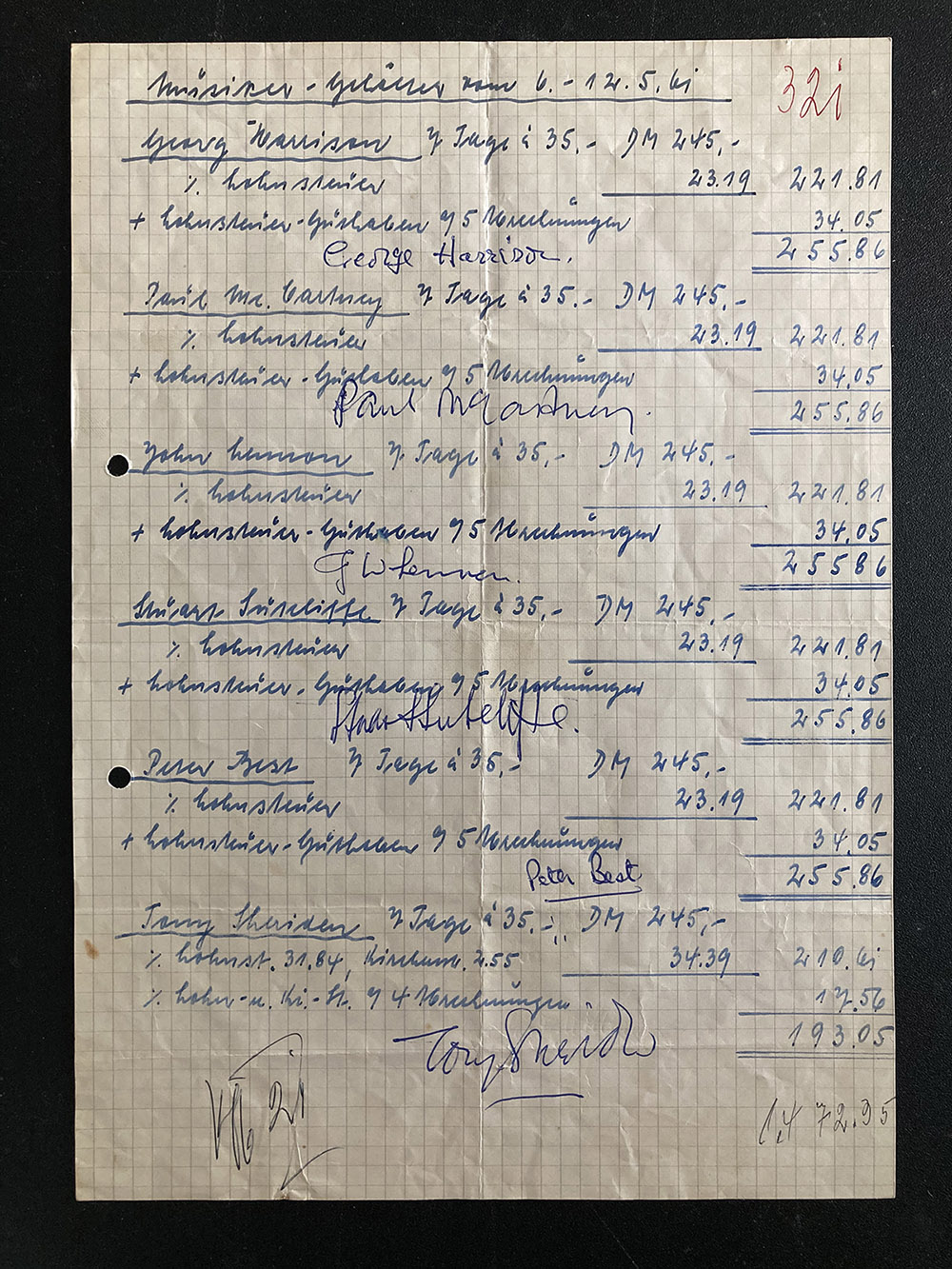
SI42. An Exceedingly Rare Pay Receipt From The Top Ten Club In Hamburg Signed By All Five Original Members Of The Beatles, May 1961
Description
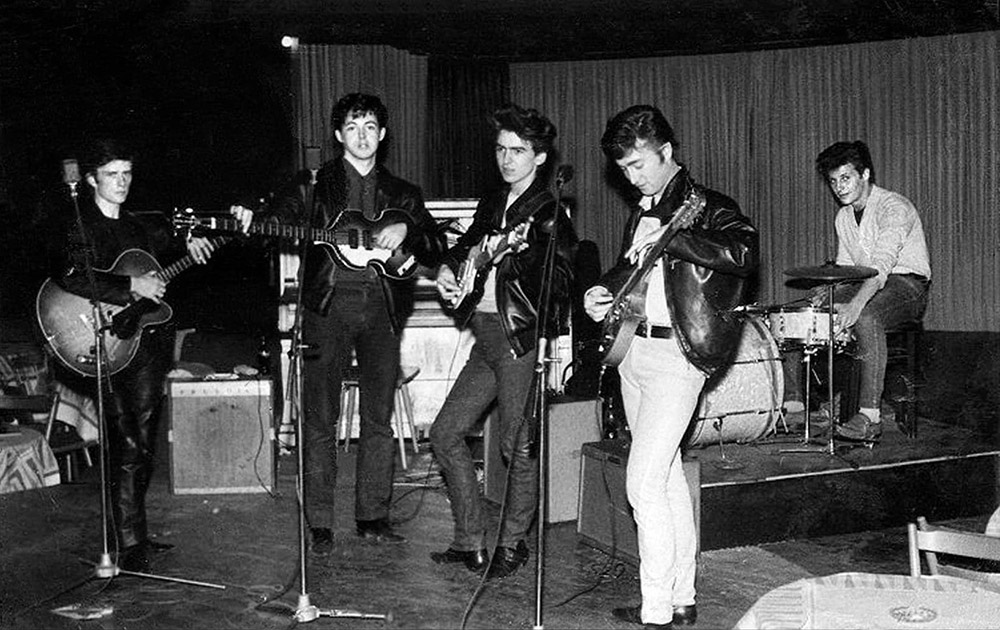
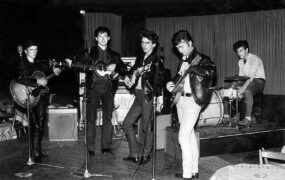
On Saturday, April 1, 1961, The Beatles embarked on their second trip to Hamburg, a stay that would last 13 weeks and encompass 92 nights and over 500 hours on stage. Their residency this time was at Peter Eckhorn’s Top Ten Club on the Reeperbahn in the St. Pauli red-light district. This wouldn’t be the first time they’d played the Top Ten. The previous fall, during their first visit to Hamburg, they had often sneaked off from the Kaiserkeller to play the newly-opened Top Ten Club which provided a more upscale setting and a far more accommodating boss than the Kaiserkeller’s “Mak Schau” master Bruno Koschmider. Their 1960 contract with Koschmider had stipulated that they could not play another club within 25 miles of the Kaiserkeller without his permission. When Koschmider heard of The Beatles’ defection, he got his payback by having the under-aged George Harrison deported, followed soon by Paul McCartney and Pete Best (whom he accused of attempting to burn down the wretched accommodations he’d provided for them behind the screen of the decrepit Bambi Kino movie theater).
Now it was a few months later — the spring of 1961 — and the band was back to play the Top Ten, fulfilling an agreement Peter Eckhorn had made with them the previous November. After a letter writing campaign conducted by Pete and his mother Mona Best to the West German Immigration Office, the deportation ban on Paul and Pete was lifted for a year. Harrison was now 18 years old and so the path to play Hamburg was cleared. A final contract with Eckhorn was negotiated and they took the stage on April 1st. The 13-week schedule was grueling. They were required to be on stage from 7 p.m. until 2 a.m. Mondays through Fridays and from 7 p.m. until 3 a.m. on weekends, with 15-minute breaks each hour. In total, they performed 503 hours in total over 92 consecutive days! Their salary was 35DM (deutschmarks) per band member per day for a total of 245DM a week for each man. At the time, the 35DM daily fee for each Beatle amounted to about 3 pounds British Sterling). While their pay was scant, the long hours helped them to dramatically improve their playing skills. Stu Sutcliffe, who had stayed in Hamburg with his girlfriend Astrid Kirchherr following the band’s first visit, joined the group on stage numerous evenings during their run of Top Ten shows.
It was during this visit that The Beatles made their first real professional recordings backing fellow Englishman Tony Sheridan for the popular German label Polydor (whose A & R man was producer/composer/orchestra leader Bert Kaempfert). These sessions held from June 22-23 produced several recordings, most notoriously the “My Bonnie” single as well as “Ain’t She Sweet” and “Cry For A Shadow”.
At the end of each week during their Top Ten tenure, the band (in addition to Tony Sheridan) was presented a single, handwritten pay receipt that they were required to sign in order to receive their playing fees. Thirteen of these receipts were created — one for each week of their 13-week stay.
Offered here is one such receipt, signed in full by all five original Beatles, acknowledging receipt of a week’s worth of wages between May 6th through 12th, 1961. Measuring 8 ¼” x 11 ¾”, the receipt – designated as number “321” in red ink at the top – has been handwritten in blue fountain pen presumably by the accountant for The Top Ten Club and each of The Beatles has signed in blue ballpoint pen for their pay of 245DM. The signatures on this document are strikingly both and clear: “George Harrison” (who was 18 at the time), “Paul McCartney” (also 18), “J.W. Lennon” (age 20), bassist “Stuart Sutcliffe (also 20, who would only live 11 more months before his tragic death from a brain hemorrhage) and drummer “Peter Best” (age 19).
This signed receipt is exceedingly scarce and is among the fewer than twenty known sets featuring the signatures of all five original Beatles with Stuart Sutcliife. When a few of these receipts first appeared at auction in 1999 and 2000, they were immediately sold and absorbed into collections. Most have never been put back onto the market. Generally speaking, full sets of Beatles signatures from 1961 with Stuart Sutcliffe are virtually impossible to find.
Here is the rare opportunity to own a stunning piece of early Beatles history — and, considering the extreme scarcity of such pieces, one that may not come along again for years to come…..SOLD